
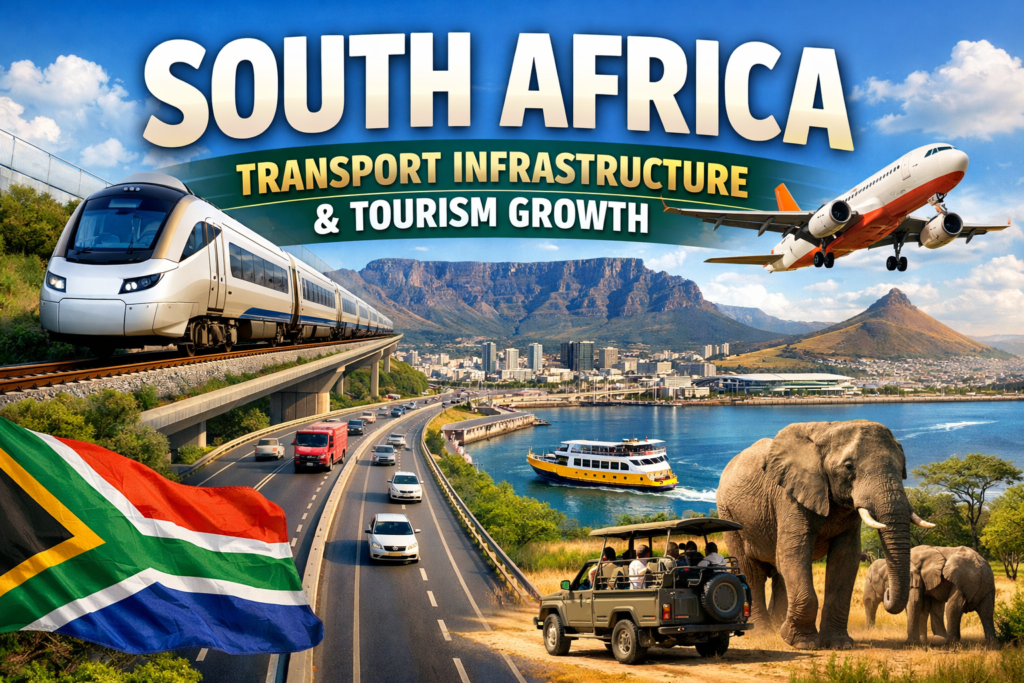
How South Africa’s Transport Infrastructure Is Holding Back Tourism Growth (and What Must Change)
South Africa transport infrastructure tourism performance is deeply interconnected. While the country remains one of Africa’s most diverse and sought-after destinations, infrastructure constraints continue to limit its full tourism potential. From deteriorating road networks and unreliable rail services to inconsistent public transport integration, these systemic challenges are not just operational issues—they are economic growth barriers.
Tourism contributes significantly to South Africa’s GDP, supports small businesses, and sustains thousands of jobs across provinces. Yet infrastructure inefficiencies reduce visitor satisfaction, increase operating costs for tour operators, and weaken international competitiveness. If tourism is to scale sustainably, transport infrastructure must evolve alongside it.
This article explores the cracks in the current system and outlines strategic, forward-thinking solutions that can help reposition South Africa transport infrastructure tourism growth on a stronger foundation.
- The State of South Africa’s Transport Infrastructure and Tourism
- Core Infrastructure Challenges Impacting Tourism Growth
- Why Infrastructure Weakness Directly Affects Tourism Growth
- Strategic Improvements That Must Be Prioritized
- The Role of Digital Planning and Data Platforms
- Creating a Competitive Advantage Through Infrastructure Intelligence
- What Stakeholders Should Do Next
- Frequently Asked Questions
- Conclusion: Unlocking South Africa’s Tourism Potential
The State of South Africa’s Transport Infrastructure and Tourism
Tourism thrives on accessibility. Travelers must be able to move safely, efficiently, and affordably between airports, cities, attractions, and rural destinations. However, several infrastructure gaps persist:
- Aging rail networks with inconsistent service reliability
- Rural road deterioration limiting access to nature reserves and heritage sites
- Fragmented public transport coordination
- Congestion in major metros
- Limited data integration across transport providers
While flagship airports and select highways operate efficiently, the broader ecosystem lacks cohesion. International visitors often encounter logistical uncertainty beyond arrival points. Domestic travelers, particularly in rural provinces, face similar challenges.
For tourism operators, this means higher vehicle maintenance costs, increased travel time, and scheduling uncertainty. For visitors, it translates to frustration, safety concerns, and reduced likelihood of repeat travel.
Core Infrastructure Challenges Impacting Tourism Growth
1. Road Quality and Rural Accessibility
Many of South Africa’s most compelling tourism experiences—wildlife reserves, coastal villages, cultural heritage routes—are located outside major urban centers. Unfortunately, secondary and rural roads often suffer from:
- Pothole proliferation
- Inconsistent maintenance cycles
- Poor signage
- Limited emergency response support
For tour operators, damaged roads increase fuel consumption and maintenance expenses. For self-drive tourists, poor conditions create safety risks and discourage exploration beyond primary hubs.
When accessibility declines, visitor distribution narrows. Tourism becomes concentrated in already saturated regions rather than spreading economic benefits to smaller communities.
2. Rail Service Instability
Rail transport once played a critical role in connecting cities and supporting scenic tourism routes. Today, inconsistent rail reliability has reduced its attractiveness for travelers.
Key concerns include:
- Schedule unpredictability
- Infrastructure vandalism
- Limited route modernization
- Declining long-distance passenger options
Rail tourism can significantly reduce congestion and environmental impact when functioning properly. Without a dependable rail backbone, road networks absorb excess pressure, increasing congestion and operational strain.
3. Fragmented Public Transport Systems
Urban transport systems often operate in silos. Taxis, buses, private shuttles, and ride-hailing platforms function independently with minimal integration.
This fragmentation results in:
- Difficulty planning seamless multi-modal journeys
- Lack of centralized information for visitors
- Limited digital transparency on schedules and pricing
- Reduced data insights for policymakers
For international tourists unfamiliar with local systems, this complexity discourages exploration and encourages reliance on expensive private transfers.
4. Congestion and Urban Mobility Strain
Major cities such as Johannesburg, Cape Town, and Durban face rising congestion. Traffic delays affect airport transfers, event tourism, conference logistics, and cruise passenger movement.
Urban congestion:
- Increases fuel costs
- Extends travel times
- Disrupts tour scheduling
- Reduces overall visitor satisfaction
In a competitive global tourism market, time efficiency matters. Infrastructure bottlenecks erode South Africa’s value proposition.
Why Infrastructure Weakness Directly Affects Tourism Growth
Transport infrastructure is not merely a logistical consideration—it shapes perception.
Visitors evaluate destinations based on:
- Ease of movement
- Safety confidence
- Reliability of services
- Time efficiency
- Comfort during transit
If movement between attractions becomes stressful, the destination’s brand suffers. Online reviews amplify these experiences, influencing future travel decisions.
Furthermore, infrastructure inefficiencies increase operating costs for travel agencies and transport operators. Rising fuel consumption, vehicle maintenance, route delays, and administrative inefficiencies shrink margins. These costs often pass to consumers, raising package prices and reducing competitiveness.
In short, South Africa transport infrastructure tourism challenges are not isolated—they cascade across the entire value chain.
Strategic Improvements That Must Be Prioritized
While large-scale infrastructure upgrades require long-term investment, several strategic improvements can yield measurable impact:
1. Prioritized Road Rehabilitation Based on Tourism Corridors
Instead of generalized upgrades, targeted investment in high-impact tourism corridors can maximize return. Mapping visitor movement patterns allows stakeholders to:
- Identify priority routes
- Allocate maintenance budgets strategically
- Improve signage and safety measures
Data-driven corridor development ensures that funding directly supports tourism growth objectives.
2. Rail Route Revitalization for Scenic and Intercity Tourism
Reinvesting in select passenger rail routes—especially those linking major tourism hubs—could:
- Reduce road congestion
- Lower carbon impact
- Create premium scenic travel experiences
- Expand regional connectivity
Rail tourism, when modernized and reliable, can become a destination experience itself.
3. Digital Integration of Multi-Modal Transport Systems
Perhaps the most overlooked opportunity lies in digital coordination.
A centralized digital planning ecosystem can:
- Integrate transport providers
- Enable real-time scheduling updates
- Offer route optimization
- Provide transparent pricing visibility
- Generate actionable movement data
Digital platforms reduce fragmentation without requiring immediate physical infrastructure overhaul. By improving coordination, stakeholders can extract more value from existing assets.
The Role of Digital Planning and Data Platforms
Digital transformation offers a strategic bridge between infrastructure limitations and tourism growth ambitions.
Modern platforms allow:
- Route mapping analytics
- Fleet optimization tools
- Demand forecasting
- Booking synchronization
- Incident reporting and monitoring
When operators, agencies, and policymakers access shared insights, decision-making improves.
For example:
- Tour agencies can design itineraries around real-time congestion trends.
- Transport operators can identify under-served routes with demand potential.
- Municipalities can pinpoint high-impact maintenance priorities.
This ecosystem approach strengthens collaboration across the tourism supply chain.
Forward-thinking digital frameworks—such as integrated management systems and booking coordination platforms—are increasingly becoming essential. Companies like Openroute, developed by KC Relics, demonstrate how centralized digital architecture can help unify fragmented transport and travel operations without exposing sensitive operational intelligence. The goal is not merely automation, but strategic visibility.
Creating a Competitive Advantage Through Infrastructure Intelligence
Global tourism competition is intensifying. Countries that combine physical infrastructure with digital coordination outperform those relying on traditional systems alone.
A digitally enabled transport ecosystem delivers:
- Improved traveler confidence
- Reduced operating inefficiencies
- Better data for investment planning
- Enhanced brand perception
Crucially, it enables proactive decision-making instead of reactive crisis management.
South Africa already possesses strong destination appeal. What is required now is infrastructure intelligence—connecting assets, analyzing performance, and aligning movement with growth strategy.
What Stakeholders Should Do Next
To strengthen South Africa transport infrastructure tourism growth, stakeholders must:
- Prioritize tourism corridor audits
- Invest in selective rail revitalization
- Encourage digital integration across transport modes
- Collaborate across public and private sectors
- Leverage data platforms to identify hidden inefficiencies
The future of tourism competitiveness will depend less on isolated upgrades and more on ecosystem coordination.
Businesses, travel agencies, and transport operators that adopt digital planning frameworks early will gain strategic advantages in cost management, reliability, and customer experience.
Frequently Asked Questions
What is the biggest transport challenge affecting tourism in South Africa?
Fragmentation and inconsistent infrastructure maintenance are major barriers. These create inefficiencies that increase costs and reduce traveler confidence.
How does poor road quality impact tourism growth?
Deteriorating roads limit access to rural attractions, increase vehicle maintenance costs, and discourage visitor exploration beyond urban centers.
Can digital platforms improve transport infrastructure performance?
Yes. While they do not replace physical upgrades, digital planning systems improve coordination, visibility, and data-driven decision-making across stakeholders.
Why is rail important for tourism development?
Reliable rail systems reduce congestion, lower environmental impact, and create unique travel experiences that diversify tourism offerings.
Conclusion: Unlocking South Africa’s Tourism Potential
South Africa transport infrastructure tourism performance remains a pivotal factor in national growth. While physical limitations exist, strategic prioritization and digital integration present powerful opportunities.
The path forward is not merely about repairing roads or upgrading rail—it is about building a coordinated, data-driven transport ecosystem that supports tourism expansion sustainably.
By combining infrastructure investment with intelligent digital systems, South Africa can unlock broader regional growth, improve visitor experience, and strengthen its competitive position on the global stage.
The opportunity is clear. The next step is decisive collaboration.