


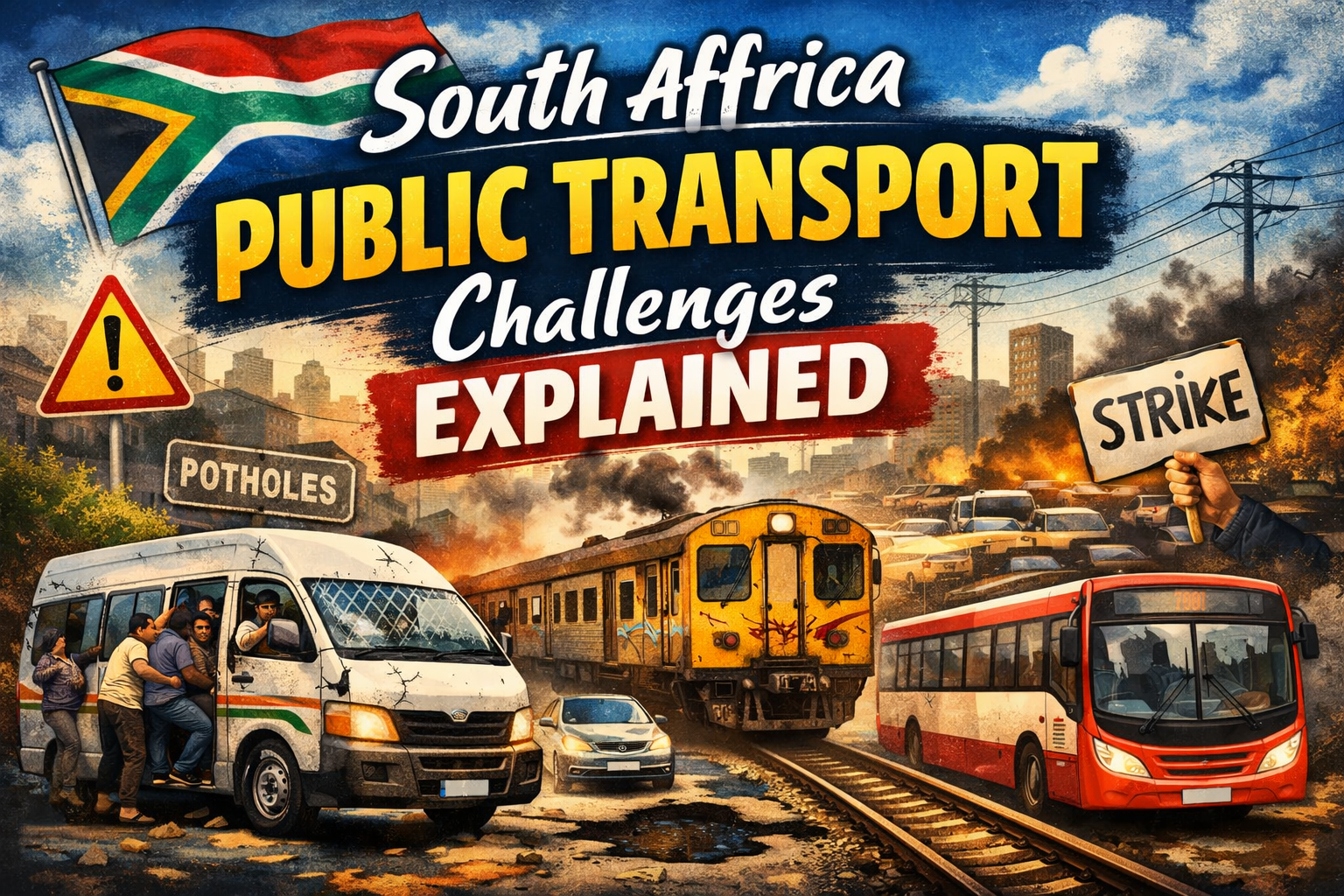
Public Transport Safety and Reliability: A Major Barrier for South African Travelers
South Africa public transport challenges remain one of the most significant obstacles to travel confidence, tourism growth, and inclusive mobility. For millions of South Africans, public transport is not optional—it is essential. Yet concerns around safety, reliability, and coordination continue to limit its potential.
From the dominance of the minibus taxi industry to inconsistent rail services and fragmented scheduling systems, the transport landscape directly influences how—and whether—people travel.
Improving public transport reliability is not simply a commuter issue. It is a tourism issue, an economic issue, and a national development priority.
- The Backbone of Mobility: Minibus Taxis
- The Struggles of Rail Services
- Safety Perception and Its Impact on Travel
- Reliability: The Hidden Cost to Tourism
- Why Coordination Matters More Than Ever
- How Technology Can Rebuild Confidence
- Strengthening Tourism Through Mobility Reform
- The Opportunity for Industry Collaboration
- Building a Culture of Trust in Public Transport
- Frequently Asked Questions
- Conclusion: Turning Mobility Into a Competitive Advantage
The Backbone of Mobility: Minibus Taxis
The minibus taxi industry carries the majority of daily commuters in South Africa. It provides flexible routing, frequent departures, and coverage in areas where formal systems fall short.
However, persistent concerns include:
- Informal scheduling practices
- Limited digital integration
- Safety compliance inconsistencies
- Communication gaps during route disruptions
While the sector fills critical gaps, its informality can reduce traveler confidence—particularly for tourists or occasional domestic travelers unfamiliar with routes.
The challenge is not eliminating informal transport—it is strengthening coordination and visibility.
The Struggles of Rail Services
Rail once offered an affordable and efficient backbone for long-distance and commuter travel. Today, unreliable train services have become symbolic of broader South Africa public transport challenges.
Common issues include:
- Service interruptions
- Infrastructure vandalism
- Delays and inconsistent timetables
- Limited coverage in key corridors
For travelers planning leisure trips or intercity movement, unpredictability discourages reliance on rail. When transport reliability decreases, travel planning becomes stressful and costly.
Without dependable rail options, pressure shifts to road transport—raising fuel costs, congestion, and emissions.
Safety Perception and Its Impact on Travel
Safety is both a measurable metric and a perception-driven decision factor.
Travelers consider:
- Road accident rates
- Vehicle maintenance standards
- Driver compliance
- Personal security in transit hubs
When safety feels uncertain, families opt out of leisure travel. Tourists may choose private transfers over public options, increasing overall trip costs.
South Africa public transport challenges therefore extend beyond infrastructure—they shape economic behavior.
Reliability: The Hidden Cost to Tourism
Unreliable transport affects more than commuters. It influences:
- Tour itineraries
- Conference attendance
- Rural tourism access
- Event participation
If a traveler cannot depend on arrival times, it impacts bookings, accommodation schedules, and overall experience quality.
Tourism thrives on predictability. When mobility systems lack consistency, visitor confidence declines.
Why Coordination Matters More Than Ever
Many of South Africa’s transport systems operate in silos. Taxi operators, bus services, rail providers, and tourism businesses often function independently without unified scheduling visibility.
This fragmentation results in:
- Duplicate routes in some corridors
- Underserved rural areas
- Poorly timed connections
- Limited data sharing
Coordinated data systems can transform these inefficiencies into structured opportunities.
How Technology Can Rebuild Confidence
Addressing South Africa public transport challenges requires modern coordination tools that enhance visibility without undermining independent operators.
1. Mobile Route and Scheduling Applications
Mobile platforms can:
- Display real-time route information
- Provide verified operator listings
- Offer departure time estimates
- Alert users to disruptions
When travelers access accurate information instantly, uncertainty decreases.
Such tools empower both locals and tourists to plan efficiently.
2. Digital Compliance Tracking
Safety confidence increases when compliance standards are visible.
Digital systems can assist with:
- Vehicle inspection tracking
- Operator licensing verification
- Driver credential monitoring
- Maintenance reporting logs
Transparent compliance data reassures users while preserving regulatory independence.
3. Integrated Booking and Payment Systems
Fragmented payment systems create friction.
Unified digital booking platforms could:
- Consolidate ticketing options
- Enable secure mobile payments
- Simplify multi-leg journeys
- Provide digital receipts and confirmations
Integrated payment ecosystems also generate valuable data for demand forecasting and route optimisation.
4. Data-Driven Route Optimization
Transport reliability improves when decisions are based on data rather than assumptions.
Advanced mobility management tools can:
- Identify high-demand corridors
- Detect underserved rural routes
- Adjust schedules dynamically
- Reduce unnecessary route overlap
Digital frameworks that respect competitive boundaries while enabling coordination can increase system-wide efficiency.
Strengthening Tourism Through Mobility Reform
Public transport reliability directly influences domestic tourism participation.
When mobility systems are:
- Predictable
- Transparent
- Safe
- Digitally accessible
more people are willing to explore beyond their immediate communities.
Tourism growth depends on affordable, reliable movement between cities, towns, and rural attractions. Without accessible public mobility, travel becomes restricted to private vehicle owners—limiting economic inclusion.
The Opportunity for Industry Collaboration
Solving South Africa public transport challenges does not require centralised control. It requires structured collaboration.
Stakeholders can include:
- Transport operators
- Tourism boards
- Municipal planners
- Technology providers
- Travel agencies
Digital coordination platforms can act as neutral facilitators—allowing stakeholders to share route visibility, scheduling data, and compliance insights without exposing proprietary pricing or sensitive business information.
This collaborative model strengthens the ecosystem while maintaining healthy competition.
Building a Culture of Trust in Public Transport
Confidence grows when systems are consistent.
Clear communication, digital transparency, and responsive scheduling create a sense of control for travelers.
As trust increases:
- More locals participate in domestic tourism
- International visitors explore beyond primary cities
- Rural destinations gain economic exposure
- Traffic congestion declines through shared mobility
Improving public transport reliability is therefore not just a commuter reform—it is an economic multiplier.
Frequently Asked Questions
What are the biggest public transport challenges in South Africa?
Safety concerns, unreliable rail services, fragmented scheduling systems, and limited digital coordination are major challenges.
How does public transport affect tourism?
Transport reliability influences traveler confidence, accessibility to destinations, and overall trip affordability.
Can technology improve public transport safety?
Yes. Mobile route tracking, digital compliance monitoring, and integrated scheduling platforms can increase transparency and confidence.
Why is coordination important?
Without coordinated data, routes overlap inefficiently, rural areas remain underserved, and travelers struggle to plan journeys.
Conclusion: Turning Mobility Into a Competitive Advantage
South Africa public transport challenges present undeniable obstacles—but also significant opportunities.
By leveraging mobile applications, digital scheduling tools, compliance tracking systems, and data-driven planning, the country can rebuild traveler confidence and unlock broader tourism participation.
Reliable public mobility strengthens domestic tourism, supports rural economies, and improves everyday life for millions.
When transport systems become transparent, coordinated, and dependable, travel becomes accessible—and opportunity expands nationwide.